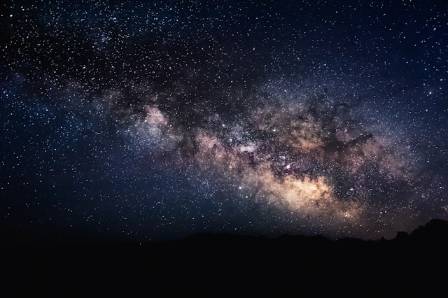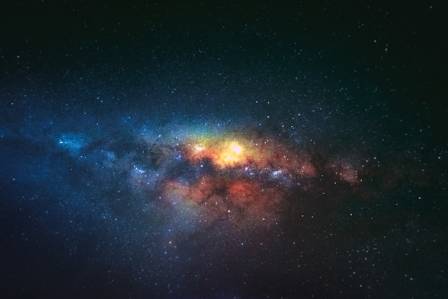
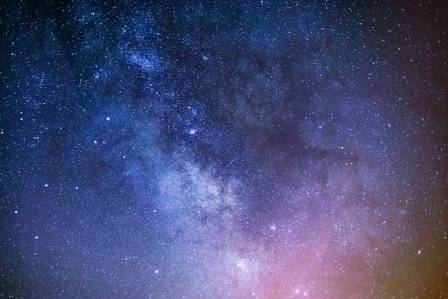
The vastness of outer space represents the region extending beyond the upper boundaries of Earth's atmosphere. It serves as the ultimate container for every celestial object known to science, including stars, planets, comets, and entire galaxies. While space is technically a vacuum—meaning it contains almost no matter—it is not a total void. It is characterized as a "hard vacuum" where the density of atoms is so low that sound cannot travel, resulting in a silent environment with an average temperature of -270.45°C.
Galactic Scale and Cosmic Origins
Current astronomical observations indicate that the universe is approximately 13.8 billion years old, having continuously expanded since its inception during the Big Bang. The scale of this expansion is immense; within the observable universe, there are an estimated 2 trillion galaxies. Our own home, the Milky Way, is just one of these, containing between 100 billion and 400 billion individual stars. Even the seemingly empty gaps between these distant galaxies are occupied by a sparse distribution of matter, averaging roughly one atom per cubic meter.
Exploration and Human Achievement
Humanity has made significant strides in understanding this frontier through direct exploration. Spacecraft have successfully reached and studied every known planet within our solar system. The most prominent human-made structure in space is the International Space Station, which remains the largest crewed object ever put into orbit. While there is no definitive physical border where space starts, the Kármán line—set at an altitude of 100 kilometers above Earth—is the most widely accepted scientific definition for the beginning of outer space.
The Architecture of the Solar System
Our solar system is a complex collection of bodies governed by the Sun's gravity. It is structured into distinct zones, starting with the inner terrestrial planets: Mercury, Venus, Earth, and Mars. Beyond these lies the Asteroid Belt, which serves as a transition to the outer solar system occupied by the gas giants, Jupiter and Saturn, and the ice giants, Uranus and Neptune. These larger worlds are often accompanied by diverse satellite systems, including notable moons such as Ganymede, Titan, and Enceladus.
The furthest reaches of our solar neighborhood are populated by dwarf planets, including Pluto, Ceres, and Eris, as well as the Kuiper Belt and the Oort Cloud. These distant regions are the primary source of comets and other icy debris. Throughout the system, smaller objects like asteroids and meteorites provide a record of the solar system's history. From the heat of the Sun to the frozen edges of the Oort Cloud, these components form a diverse and highly organized celestial environment.