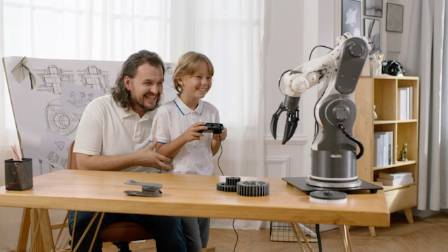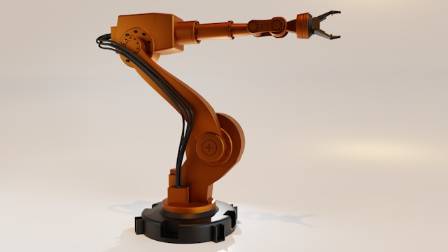
A robotic arm is a programmable mechanical apparatus designed to replicate the movements of a human arm. It employs motorized joints to position a tool, gripper, or sensor in three-dimensional space. Robotic arms come in a variety of sizes, from compact desktop models to massive systems such as the 17-meter-long arm on the International Space Station. As of 2024, over 4.6 million industrial robotic arms are in use globally—a figure that has roughly doubled over the past ten years.
How Robotic Arms Operate
Robotic arms are constructed from rigid segments connected through powered joints. Each joint adds a “degree of freedom,” which refers to an independent direction the arm can move. The most common type is the revolute joint, rotating like an elbow or shoulder. A prismatic joint moves linearly, similar to a sliding drawer. Some joints combine multiple motions: a ball-and-socket joint provides three degrees of freedom in a single connection, mimicking the shoulder’s range of motion.
Industrial arms typically have six degrees of freedom, allowing them to reach virtually any location and orientation within their working space. Generally, three joints handle positioning (up/down, left/right, forward/back), while the remaining three control the tool’s orientation. Some arms have seven degrees of freedom, enabling them to maneuver around obstacles similarly to how humans can reposition an elbow without moving the hand.
At the arm’s tip is the end effector, the component that performs the actual task. Without it, the arm merely functions as a precision positioning system.
End Effectors: The Working Component
End effectors—also called end-of-arm tooling—are interchangeable attachments that define what tasks the robotic arm can perform. They fall into three categories:
Grippers: Designed to grasp objects, they can be vacuum-based, pneumatic, hydraulic, or electric. Soft robotic grippers are increasingly common, useful for delicate objects like electronics or produce.
Process tools: Used for fabrication or alteration, including welding torches, cutting tools, paint sprayers, adhesive applicators, and 3D printing heads.
Sensors: Allow the arm to perceive its environment. Force and torque sensors detect applied pressure, cameras provide vision, and ultrasonic or proximity sensors help with navigation or part verification.
Many robotic arms can automatically switch end effectors, allowing a single machine to transition from welding to inspection tasks in seconds.
Four Popular Arm Configurations
Not all robotic arms mimic human anatomy. Different designs serve specialized purposes:
Articulated arms: The most familiar type, with rotary joints in a chain. Typically six joints allow the arm to move across multiple planes, ideal for welding, assembly, and machine tending.
SCARA arms: Compliant in horizontal motion but rigid vertically. These are fast and cost-effective for tasks between parallel surfaces, like inserting components into circuit boards.
Delta arms: Ceiling-mounted, with parallelogram linkages that keep the moving parts light and enable extremely high-speed movements, ideal for pick-and-place operations in packaging or manufacturing.
Cartesian arms: Linear actuators along X, Y, and Z axes provide sliding motion. They are space-efficient and scalable, commonly used in 3D printing and CNC machining.
Precision, Speed, and Payload
Two key metrics for robotic arms are accuracy and repeatability. Accuracy measures how close the arm comes to a commanded position, while repeatability indicates how consistently it can return to the same point. Slower motion generally increases precision. Low-cost arms may achieve 0.9–2.5 mm accuracy depending on speed, whereas high-end industrial models can operate within hundredths of a millimeter. Surgical robots push even further, achieving sub-millimeter precision.
Payload capacity varies widely: small arms handle a few kilograms, while the largest industrial models can lift up to 600 kg, capable of moving engines or fully loaded pallets.
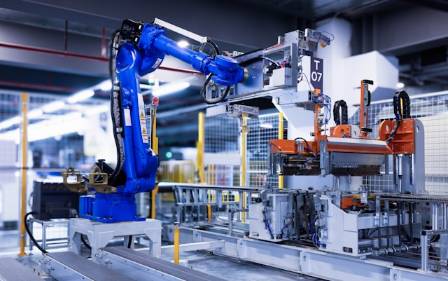
Industrial and Manufacturing Applications
Robotic arms are primarily used in production environments. Welding remains a staple, with arms following programmed paths to fuse metal components. Material handling, assembly, painting, palletizing, and inspection are other common applications. Their advantage is consistency—they perform repetitive motions tirelessly and without variation.
Medical and Surgical Applications
Surgical robots allow surgeons to operate with extreme precision through small incisions, translating large hand motions into delicate micro-movements. Six-degree-of-freedom arms with ±0.1 mm repeatability are typical. In dental implant procedures, real-time 3D tracking reduces errors from several degrees to just 0.33 mm at the entry point. Robotic arms also assist in rehabilitation, prosthetics, and lab automation, ensuring contamination-free and precise handling of samples.
Space Robotics
The Canadarm2 on the International Space Station is a 17-meter robotic arm with seven degrees of freedom, mirroring human arm articulation. It captures cargo, repositions modules, and assists astronauts on spacewalks. Unique to Canadarm2, it can “walk” along the station by detaching and reattaching, extending its reach beyond a fixed base.
Collaborative Robots (Cobots)
Unlike traditional industrial arms that require safety cages, cobots are designed to work alongside humans. They feature force-limiting sensors, lower speeds, and rounded edges to prevent injury. Cobots can be guided manually through tasks, allowing quick reprogramming and adaptability. They are widely used in small-batch manufacturing, labs, and workplaces where robots handle repetitive lifting while humans manage decision-making.