Introduction: The Vigilant Desert Dweller
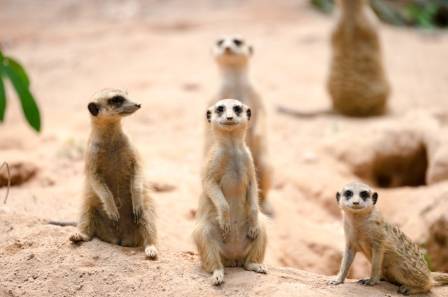
The meerkat (Suricata suricatta) is a small, charismatic mammal renowned for its upright vigilant posture and intricate social behaviors. Native to the arid regions of southern Africa, this member of the mongoose family (Herpestidae) thrives in harsh desert environments, showcasing remarkable adaptability and cooperation. From their specialized physical traits to their tight-knit group dynamics, meerkats offer a compelling example of how teamwork and evolutionary adaptations enable survival in challenging habitats. This article explores their scientific classification, physical characteristics, habitat, behavior, diet, reproduction, predators, conservation status, evolutionary history, relationship with humans, and unique quirks.
Scientific Classification
Belonging to the kingdom Animalia, phylum Chordata, class Mammalia, order Carnivora, and family Herpestidae, the meerkat is classified under the genus Suricata, with Suricata suricatta as its sole species. This taxonomic placement links it to other mongooses but distinguishes it through its small size, highly social lifestyle, and specialized adaptations for desert living—traits that set it apart from other members of its family.
Physical Characteristics
Meerkats are small mammals, typically weighing 0.62 to 0.97 kg (1.4 to 2.1 lbs) and measuring 24 to 30 cm (9.4 to 11.8 inches) in body length, with a slender tail adding 19 to 24 cm (7.5 to 9.4 inches) for balance. Key physical adaptations include light brown fur with distinct dark bands on the back and a paler underside, a pointed snout for foraging, dark eye patches that reduce glare, sharp curved forelimb claws for digging, and a long tail that stabilizes them when standing upright. These features are critical for navigating arid landscapes, digging burrows, locating food, and detecting predators.
Habitat
Meerkats inhabit the arid and semi-arid regions of southern Africa, including the Kalahari Desert, Namib Desert, and parts of Angola, Botswana, Namibia, and South Africa. Their preferred habitats are characterized by sparse vegetation, sandy or loamy soils (ideal for digging), and extreme temperature fluctuations—hot days and cold nights. They live in complex underground burrows dug with their powerful forelimbs, featuring multiple entrances, tunnels, and chambers that provide shelter from harsh weather and predators. These burrows are often shared and maintained by entire groups, serving as permanent homes and safe havens for raising young.
Behavior: Cooperative Social Dynamics
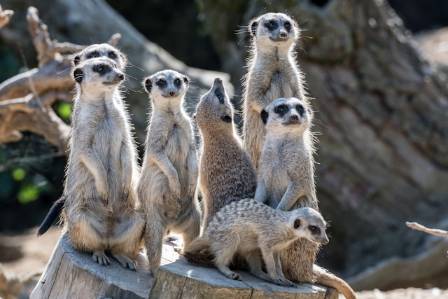
Meerkats are highly social animals, living in groups called “mobs” or “clans” that typically consist of 20 to 30 individuals (though larger groups of up to 50 have been observed). Their behavior is defined by cooperation: members take turns foraging while one or two act as sentinels, standing upright on their hind legs (using their tails for balance) to scan for predators. They engage in regular mutual grooming to strengthen social bonds and maintain hygiene, and they communicate through a range of vocalizations—each tailored to warn of specific threats (e.g., birds of prey vs. ground predators). This collective behavior is central to their survival, as cooperation enhances foraging efficiency, predator detection, and protection of young.
Diet: Versatile Feeders of the Desert
Primarily insectivores, meerkats have an omnivorous diet that adapts to food availability in their harsh habitat. Their main prey includes beetles, spiders, caterpillars, and other insects, but they also hunt small vertebrates like lizards, rodents, and bird eggs. When insects are scarce, they supplement their diet with plant matter such as roots, tubers, and fruits. A remarkable trait is their resistance to scorpion venom, allowing them to safely hunt and consume these dangerous arachnids—an adaptation that expands their food sources in resource-poor environments. Their versatile feeding habits ensure they can survive even during dry spells when prey is limited.
Reproduction: Cooperative Breeding
Meerkat reproduction is dominated by a single dominant breeding pair within each mob, with other adult members acting as helpers (“babysitters”) to raise the young—a behavior known as alloparenting. The gestation period lasts approximately 11 weeks, and litters typically consist of 3 to 4 pups (range 1 to 5). Pups are born blind, hairless, and helpless, remaining in the burrow for the first 3 to 4 weeks and relying on the dominant female’s milk and the care of group members. By 3 weeks old, pups begin accompanying the group to forage, learning hunting skills from adults. Cooperative care increases pup survival rates, as helpers defend the burrow, carry pups to safety, and share food.
Predators: Threats and Defense Strategies
Despite their vigilance, meerkats face numerous predators. Aerial threats include eagles, hawks, and falcons, while ground predators include jackals, mongooses, snakes (such as Cape cobras, which often invade burrows to prey on pups), and large lizards. Their primary defense is the sentinel system: sentinels emit distinct vocal warnings when predators are detected, prompting the group to scramble into burrows, hide under vegetation, or mob smaller predators. Their small size and agility also help them evade threats, while their burrows provide a secure retreat. Cooperation in defense—multiple meerkats confronting small predators—further enhances their chances of survival.Conservation Status
According to the IUCN Red List, meerkats are classified as Least Concern, with a stable global population. Their adaptability to harsh environments, versatile diet, and cooperative social structure have allowed them to withstand habitat changes in some areas. However, future threats may include habitat destruction from human expansion, livestock grazing, and climate change—factors that could alter their food sources and reduce suitable burrowing habitats. Currently, no major conservation interventions are needed, but monitoring of human-wildlife interactions and habitat loss is essential to maintain their population stability.
Evolutionary History
Meerkats evolved within the mongoose family (Herpestidae), with ancestors that likely adapted to African desert environments millions of years ago. Fossil evidence suggests their distinct features—such as digging claws, vigilance adaptations, and social behavior—emerged in response to evolutionary pressures: the need to find food in arid landscapes, avoid predators in open habitats, and raise young in safe burrows. Their cooperative breeding and group living are thought to have evolved because they enhance survival in resource-poor, high-risk environments—traits that have made them one of the most successful desert mammals in southern Africa.
Relationship with Humans
Meerkats have become popular among humans due to their charismatic appearance and social behaviors, featured prominently in wildlife documentaries (e.g., Meerkat Manor) and zoo exhibits. In the wild, they rarely interact with humans, avoiding settlements and human activity. Their media portrayal has raised public awareness and appreciation for the species, though it is important to recognize them as wild animals that thrive best in their natural habitats. Zoos often study their social dynamics to understand cooperative behavior, and they are occasionally kept in wildlife parks, but they are not domesticated and require specialized care.
Interesting Facts About Meerkats
Meerkats boast several unique traits: they are immune to many venoms (including scorpion and some snake venoms), allowing them to hunt dangerous prey; they have a complex vocal repertoire with over 10 different calls to communicate specific threats and social cues; their iconic upright posture is exclusively for vigilance, not display; non-breeding adults invest heavily in raising the dominant pair’s young (alloparenting), which boosts group survival; and their burrows are architectural feats—some have over 100 entrances and connect to neighboring groups’ burrows, forming large underground networks.
Conclusion: The Remarkable Resilience of Meerkats

Meerkats are extraordinary creatures, defined by their cooperation, adaptability, and unique evolutionary adaptations. Their ability to thrive in harsh desert environments, relying on group dynamics for survival, offers a powerful example of how social behavior can overcome ecological challenges. From their venom resistance to their complex burrows and vocal communication, every aspect of their biology is tailored to their habitat. As long as their arid habitats are protected from excessive human disturbance and climate change impacts, meerkats will continue to captivate with their intelligence, agility, and tight-knit social bonds—reminding us of the beauty and complexity of cooperative life in the wild.