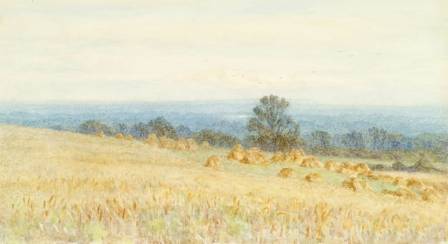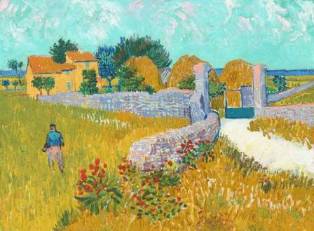
Claude Monet’s Haystacks series is one of the clearest demonstrations of his lifelong fascination with capturing light and its shifting effects on objects and landscapes. Through repeated observation of the same subject, Monet explored how illumination transforms color, atmosphere, and perception across different times of day and changing seasons.
Monet was known for painting the same scenes repeatedly, producing multiple series of works throughout his career. Among them, the Water Lilies series is the most widely recognized, consisting of around 250 paintings and forming one of his largest artistic projects.
Although the Water Lilies are more famous, the Haystacks series is highly respected in the art world and is often regarded as one of Monet’s most accomplished bodies of work. While later series such as Water Lilies, Japanese Bridge, and The Artist’s Garden tend to focus on close, immersive perspectives with little or no horizon line, the Haystacks paintings retain broader landscapes, often including distant fields, tree lines, and open skies.
Subject Matter: Rural Harvest Scenes
As the title indicates, the series centers on stacks of hay (or grain) left in fields after harvest. These simple rural forms became the perfect subject for Monet’s exploration of changing light conditions.
To complete the series, Monet arranged access to farmland near his residence in Giverny. A local farmer allowed him to work in the fields over an extended period covering multiple seasons. Over approximately 18 months, from 1890 to 1891, Monet painted these scenes within a short distance of his home—never more than a few kilometers away in the French countryside.
Most compositions include two or three haystacks rather than just one, allowing him to study depth, spacing, and shadow interaction within the same landscape.
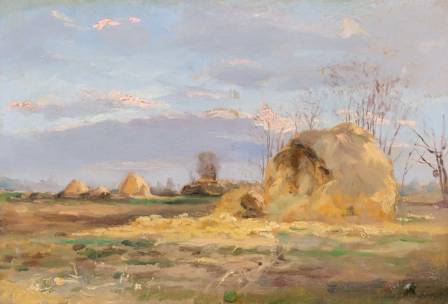
Light, Weather, and Seasonal Change
A key feature of the series is Monet’s careful attention to changing environmental conditions. He painted the haystacks at different hours of the day to observe how sunlight altered their appearance.
Most works were completed during late spring and summer when light conditions were relatively stable. However, Monet also produced paintings during winter, where snow-covered fields and low sunlight created entirely different visual effects.
Winter proved especially challenging. The rapid shifts in light forced Monet to revisit the same scene multiple times in order to achieve consistency. This method of returning to earlier canvases under similar lighting conditions became a hallmark of his working process, also seen in other series such as his studies of Rouen Cathedral.
Working Method and Artistic Process
Monet often worked on several canvases simultaneously. During a single day, he might paint for only a short time on each one, moving between them as lighting conditions changed.
His assistant would frequently transport partially completed works from his studio back to the fields so Monet could continue painting under matching light conditions. This flexible approach allowed him to accurately capture fleeting atmospheric effects.
Because haystacks cast strong and shifting shadows, even small changes in sunlight dramatically altered their appearance, making them ideal subjects for his Impressionist techniques.
Artistic Impact and Legacy
The Haystacks series is particularly celebrated for its vivid depiction of sunsets, atmospheric variation, and color transformation. It stands as one of Monet’s most influential achievements in exploring perception and natural light.
In modern times, individual paintings from the series have reached extraordinary auction prices. One example sold at Sotheby’s for over $110 million, ranking among the most expensive Impressionist works ever sold.
Today, most of the approximately 25 paintings in the Haystacks series are housed in public museums around the world, allowing audiences to continue experiencing Monet’s groundbreaking exploration of light, nature, and time.