A well-designed beach house must endure shifting sands, strong winds, and uneven terrain. The most innovative coastal homes incorporate features like elevated foundations for stability, panoramic views, inner courtyards for shelter, and protective shutters for extreme weather conditions. Whether along the dramatic shores of Scotland or the rugged coastline of California’s Big Sur, the design must harmonize with both the landscape and the elements.
Danish architect Mette Lange, author of Earth, Sky & Water, explains, "Since the weather is unpredictable on the Danish coast, we design beach homes with outdoor nooks that offer protection from different wind directions."
Similarly, Tom Kundig of Seattle-based Olson Kundig Architects considers factors such as how much homeowners want to interact with the beach and whether privacy is a concern. With thoughtful design and an adaptable mindset, a coastal home can be enjoyed year-round.
1. Shelter in the Dunes – Jutland, Denmark (Mette Lange)
The Jutland Peninsula is known for its relentless western winds, making outdoor spaces challenging. This compact home, positioned close to the shore on a steep incline, features a south-facing courtyard that provides a protected outdoor space all year. "From the courtyard, you can see straight through the house to the sea," Lange notes.
The surrounding landscape consists of marram grass, which stabilizes the dunes, and the home was designed to have minimal environmental impact. Its tiered structure follows the natural slope, reducing wind exposure, while deep overhangs shield the south-facing façade from the harsh midday sun.
2. Courtyard Retreat – Ordrup Næs, Denmark (Mette Lange)
Nestled in a peninsula village near Copenhagen, this home blends seamlessly with its environment. Thanks to its sheltered location, glass sliding doors on either side of the living room can fully open, creating a veranda-like effect. A west-facing inner courtyard allows the last light of the day to filter inside, while adjustable louvered doors provide shade when necessary.
Despite a spacious lot, building regulations limited the structure to a triangular footprint of under 300 square meters due to setbacks from the coastline. The exterior features vertical cedar panels and mahogany-framed windows, which will weather over time to a silvery-grey finish.
3. Bilgola Beach House – Sydney, Australia (Olson Kundig)
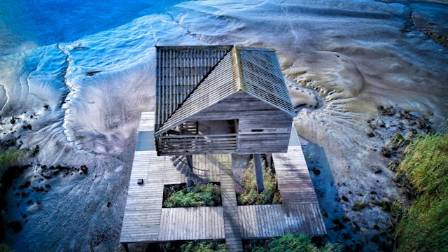
Sydney’s Bilgola Beach is known for intense storms, strong winds, flooding, and scorching sun. To address these challenges, this home is elevated on concrete piles, allowing sand and water to move freely beneath it.
A custom shutter system can fully enclose the house during extreme weather. Inside, a central courtyard channels natural light, and a water feature helps regulate indoor temperatures. The board-formed concrete walls are tinted to resemble the surrounding dunes and cliffs, giving the structure a natural aesthetic.
4. Carbon Beach House – Malibu, California (Olson Kundig)
Unlike remote coastal retreats, this home sits between Malibu Beach and the busy Pacific Coast Highway. To maintain a connection to the ocean while ensuring stability, the house is built on a self-draining pier, protecting it from storm surges and high tides.
A solid concrete façade buffers the home from the highway’s noise, while the ocean-facing side opens completely to the sea. A glass-lined inner courtyard and cactus garden introduce natural light and greenery. Adjustable kinetic louvres allow residents to control sunlight, privacy, and security when the house is unoccupied.
5. I/O Cabin – Risør, Norway (Erling Berg)

On Norway’s southern coast, traditional homes have pitched roofs, but Erling Berg’s I/O Cabin defies convention with a flat, cantilevered roof. Influenced by California’s mid-century modernism, this design can support up to one meter of snow.
The structure consists of three separate volumes, each connected by a spacious deck, providing seamless indoor-outdoor living. Elevated on wooden stilts, the cabin adapts to the sloping landscape, and its locally sourced spruce siding was treated with natural grey pigments, giving it an instant weathered look reminiscent of Norway’s mid-century summer homes.
6. Casa Acantilado – Zihuatanejo, Mexico (Zozaya Arquitectos)
Situated 150 miles northwest of Acapulco, this home embraces traditional Mexican coastal architecture with a large palapa—a thatched, open-sided structure that shades communal spaces and enhances natural ventilation.
The property is accessed from the upper level due to its steep, rocky terrain. Each bedroom has a private terrace, and the home's angular design ensures all rooms have unobstructed Pacific Ocean views. The structure consists of geometric concrete volumes, some left exposed for a raw, natural aesthetic.
7. Big Sur Coastal Retreat – California, US (Field Architecture)
The Big Sur coastline is defined by towering Santa Lucia mountains, volatile weather, and rapid coastal erosion. Here, a home must withstand seismic activity, strong winds, winter storms, and corrosive ocean spray.
During construction, the architects discovered an ancient ravine that had been filled in over time. Instead of removing it, they restored the waterway and designed the house as two separate structures connected by a glass bridge. The south-facing overhangs protect interiors from the intense California sun.
8. Caochan na Creige – Outer Hebrides, Scotland (Izat Arundell)
Located in Harris Bay, this home takes inspiration from Scotland’s historic blackhouses, traditional stone dwellings with curved layouts. Built from local Lewisian Gneiss rock, the structure seamlessly integrates with its rugged environment.
Positioned within a sheltered inlet, the windows are arranged to track sun movement throughout the day. Initially, the design included a sunken living area, but after discovering solid rock beneath, the plan was altered. "In retrospect, I think the final design is even stronger because of these changes," says Eilidh Izat.
This house was entirely hand-built by Arundell, Eilidh’s brother Alasdair Izat, and stonemason Dan Macaulay. Construction began in January 2022, enduring nine named storms before completion 18 months later.
Final Thoughts
From Australia’s storm-prone beaches to Norway’s snowy shores, these coastal homes showcase ingenious architectural solutions that balance functionality, beauty, and resilience. By embracing local materials, innovative layouts, and adaptive designs, these homes prove that a well-crafted beach house can withstand nature’s forces while providing a stunning retreat.