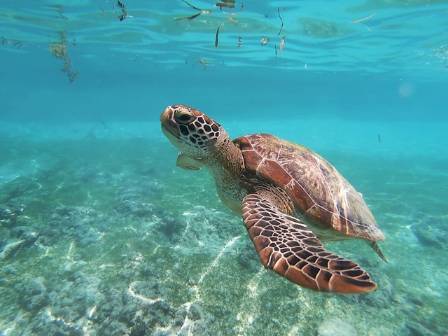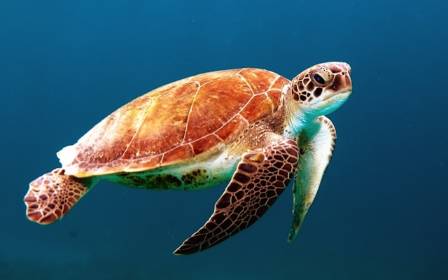
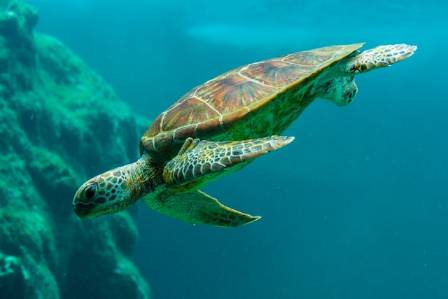
Sea turtles are reptiles uniquely adapted to marine life. Their streamlined bodies, large size, and strong front flippers enable them to dive deeply and swim long distances. The front flippers are elongated and resemble wings, while the back flippers are shorter and more paddle-like. Although they can remain underwater for hours while resting, sea turtles surface periodically every hour or so to breathe.
There are seven recognized species of sea turtles: the green sea turtle, Hawksbill, loggerhead, olive ridley, Kemp’s ridley, leatherback, and flatback.
These ancient reptiles have existed for over 110 million years, showing little evolutionary change. Most species have a top shell, or carapace, made of fused bones covered with hard scales called scutes. Unlike land turtles, sea turtles cannot retract their heads into their shells. Adult ridleys are the smallest, weighing 85–100 pounds (38–45 kg), while leatherbacks are the largest, reaching up to 2,000 pounds (900 kg). Sea turtles grow slowly and can live for several decades.
Distribution
All sea turtle species are found in U.S. waters except the flatback, which is restricted to Australian coastal regions.
Life Cycle
Sea turtles typically reproduce every two to three years in shallow coastal waters. During the summer, females come ashore to nest, digging holes with their back flippers and laying 80–150 eggs that resemble small white balls. After laying, the turtles cover and conceal the nest before returning to the ocean. A female may return multiple times during a single nesting season.
The temperature of the sand where eggs are incubated determines the sex of the hatchlings: warmer sands produce more females, cooler sands yield more males. Conservationists often leave eggs in place so that the sex ratio is determined naturally.
Hatchlings emerge about two months later, usually at night, and rely on the moonlight and open sky to find the ocean. After reaching the water, males rarely return to shore, while females come back only to lay eggs in subsequent years. Artificial lights along beaches can disorient hatchlings, so many coastal communities enforce lighting regulations during nesting season.
Conservation
All sea turtles are considered threatened or endangered. They face numerous dangers, including habitat loss from coastal development, marine pollution, accidental capture in fishing gear, and illegal trade for meat and shells.
In the United States, sea turtles are managed jointly by the U.S. Fish & Wildlife Service (nesting beaches) and the National Marine Fisheries Service (marine environments).
Interesting Fact
Though sea turtles lack teeth, their strong jaws are capable of crushing, biting, and tearing food.
Sources
Animal Diversity Web, University of Michigan Museum of Zoology
Florida Fish and Wildlife Conservation Commission, Fish and Wildlife Research Institute
National Marine Fisheries Service, NOAA
Sea Turtle Conservancy
U.S. Fish & Wildlife Service