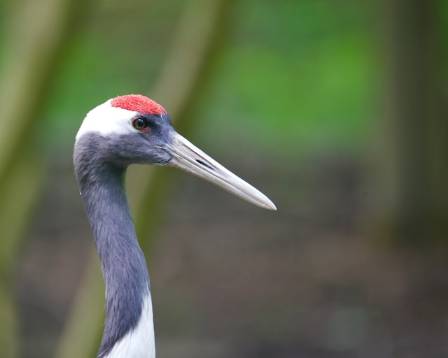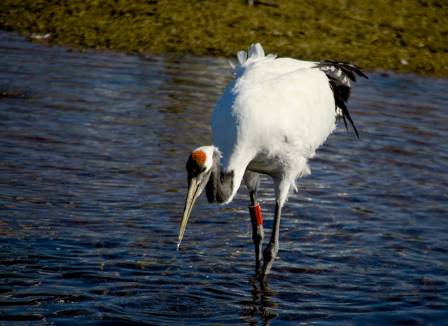
The red-crowned crane is among the largest crane species in the world. It is strongly associated with aquatic environments and often forages in deeper waters compared to most other crane species.
Physical Appearance
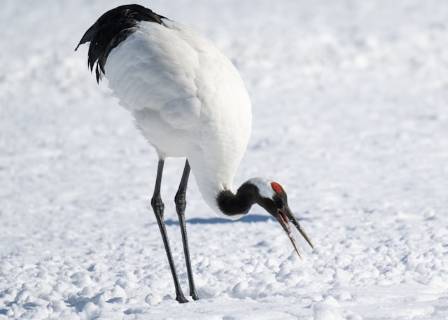
This crane is mainly covered in pure white plumage, with contrasting black feathers on the face, neck, and parts of the wings. A distinctive red marking sits on the top of its head, which is the origin of its name. White feathers extend from behind the eyes down to the back of the head. The wings include black secondary and tertiary feathers, adding contrast to its elegant appearance.
Its bill is long, pointed, and slightly angular, adapted for catching prey in water. Both males and females share the same coloration, although males are generally slightly larger.
Young cranes look quite different from adults. Juveniles display mixed plumage of white, gray, cinnamon, and light brown tones. Their neck area is grayish to brown, and their wings are darker with muted black and brown feathers. The head and forehead are covered in grayish and tawny tones. Their legs and beaks resemble those of adults but are lighter in color. By around two years of age, juvenile feathers are gradually replaced by the pure white adult plumage.
Size
The red-crowned crane is one of the tallest crane species globally. It can reach a height of about 158 cm (around 5 feet), with a wingspan extending up to 2.5 meters (8 feet). Its body weight typically ranges from 7 to 15 kg (15 to 26 pounds).
Natural Habitat
Red-crowned cranes are highly dependent on wetland ecosystems and occupy large territories across southeastern Russia, northeastern China, Mongolia, and parts of eastern Japan. Unlike many other cranes, they often feed in deeper water zones. They also search for food in grasslands, especially in Japan.
During winter, they inhabit coastal marshes, riverbanks, freshwater wetlands, rice fields, and agricultural lands. They prefer nesting in marshy areas with standing water and dense, dead vegetation.
These birds are well adapted to cold climates. Populations from Russia and China migrate to wintering sites such as the Yellow River Delta, coastal Jiangsu in China, and the Korean Demilitarized Zone. Japanese populations, however, remain in the same region year-round and do not migrate.
Lifespan
In the wild, their lifespan is not precisely known, but in captivity they typically live to a median age of about 15.1 years for both males and females.
Vocalization and Communication
Red-crowned cranes produce loud, high-pitched, rattling calls described as a “kar-r-r-o-o-o” sound with variations. These vocalizations play an important role in communication between individuals.
Diet and Feeding Behavior
These cranes are omnivores, feeding in marshes on a diverse diet that includes aquatic insects, small fish, amphibians, rodents, reeds, grasses, berries, corn, and other plant material. During winter, they often feed in rice fields. In Japan, artificial feeding stations supply corn to support populations. In managed care, their diet may include specialized pellets, worms, insects, and small fish.
Social Structure
Red-crowned cranes are highly social and typically live in flocks. Family groups form the core of their social organization and are considered the largest stable social units among cranes.
Reproduction and Growth
These cranes are usually monogamous, forming long-term pair bonds. Nests are built on wet ground or shallow water. Females typically lay two eggs, and both parents share incubation duties for 29 to 34 days. Males are especially protective of the nest.
Chicks begin flying at around 95 days old. At approximately three months, they start accompanying their parents while foraging. They become capable fliers by autumn. Young cranes remain with their parents until the next breeding cycle, after which they become independent.
Conservation Status and Threats
The red-crowned crane is one of the rarest crane species, second only to the whooping crane of North America. Its greatest threat is the loss and degradation of wetlands due to agriculture, industrial development, and urban expansion. As habitats shrink, cranes become concentrated in fewer suitable areas.
Current estimates suggest that only about 1,700 to 2,700 individuals remain across East Asia, according to the IUCN Red List.
Conservation Programs and Captive Breeding
The Smithsonian Conservation Biology Institute (SCBI) has contributed to conservation efforts by sending crane eggs to Russia’s Khinganski Nature Reserve, where chicks were raised and released into the wild. Around 150 eggs were transferred between 1995 and 2005.
Although this program has been paused, international cooperation among Russia, China, Japan, and Korea remains essential for the species’ survival. Habitat destruction continues to be the most urgent issue.
SCBI remains an important facility for crane research and breeding, using advanced techniques such as artificial insemination and egg sexing. However, no current reintroduction programs exist for this species. Due to limited space and genetic considerations, breeding is carefully managed under species survival guidelines.
How to Help
Supporting conservation organizations like the Smithsonian National Zoo and similar institutions can help protect red-crowned cranes and other endangered wildlife. Donations, volunteering, and spreading awareness all contribute to conservation efforts.
Additionally, reducing consumption and choosing reused or repurposed goods instead of new products can help lower environmental pressure and indirectly support habitat preservation.