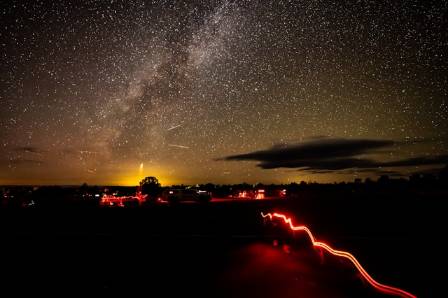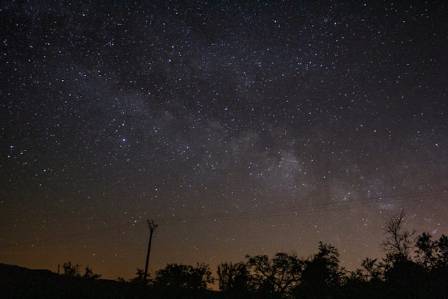
Today, most Americans—and much of the global population—live under skies significantly dimmed by artificial light. This widespread glow obscures the natural night sky, to the extent that over two-thirds of people in the U.S. can no longer see the Milky Way from their homes.
Experiencing the night sky in its full splendor—thousands of shimmering stars, bright planets, the soft arc of the zodiacal light, meteor showers, and other celestial wonders—is one of the great rewards of venturing into rural or wild areas.
Growing recognition of the value of truly dark skies has led to conservation efforts worldwide. The International Dark-Sky Association (IDA), based in Arizona, has certified close to 200 Dark Sky Places globally, including many International Dark Sky Parks, Reserves, and Sanctuaries across the United States. These locations not only offer exceptional stargazing but also promote astronomy education and work to minimize light pollution.
The sites listed below—most with official IDA recognition—provide brilliantly clear night skies perfect for unaided stargazing. (Though bringing binoculars or a telescope is always a good idea!)
What’s more, the landscapes beneath these stellar displays are equally breathtaking. Whether you’re surrounded by mountains, canyons, or vast forests, observing constellations, meteors, and the Milky Way becomes an even more magical experience.
Top Stargazing Locations
We’ve organized these exceptional sites roughly by region, starting in the Southwest and moving northwest, then east and south.
(1) Big Bend Region, Texas
The Chihuahuan Desert landscape of Big Bend—with its desert grasslands, deep canyons along the Rio Grande, and the Chisos Mountains—forms one of the most unique and least-visited national parks in the U.S. Its remote location and dry, clean air also make it one of the country’s premier stargazing destinations. Research indicates Big Bend National Park has the darkest skies of any national park in the contiguous U.S. The region includes the national park, Big Bend Ranch State Park (both IDA Dark Sky Parks), and the Black Gap Wildlife Management Area (a Dark Sky Sanctuary), all offering profound darkness.
(2) Death Valley National Park, California
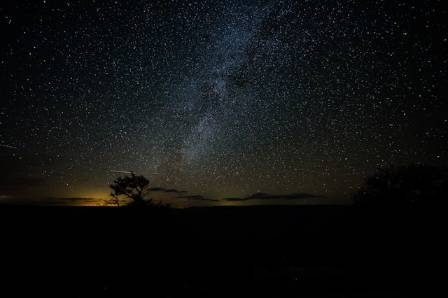
Famed for extreme heat and aridity, Death Valley also boasts exceptionally dark skies relatively close to Southern California’s cities. Its vast, empty terrain and distance from urban centers like Las Vegas earn it IDA Gold Tier status—the highest dark sky rating. Prime stargazing spots include Ubehebe Crater, Mesquite Flat Sand Dunes, and Badwater Basin, the lowest point in North America.
(3) Natural Bridges National Monument, Utah
Located in the canyon country of southeastern Utah, Natural Bridges became the first IDA International Dark Sky Park in 2007. It offers some of the nation’s darkest skies within the National Park System, enhanced by the stunning backdrop of three massive stone bridges: Sipapu, Owachomo, and Kachina.
(4) Great Basin National Park, Nevada
One of the least-visited national parks, Great Basin features basin-and-range topography, 13,063-foot Wheeler Peak, ancient bristlecone pine groves, and superb stargazing thanks to high elevation, dry air, and minimal light pollution. An IDA Gold Tier Dark Sky Park, it hosts an annual Astronomy Festival and offers awe-inspiring views of the cosmos above its timeless landscapes.
(5) Central Idaho Dark Sky Reserve, Idaho
The first International Dark Sky Reserve in the U.S. covers nearly 1,500 square miles of the Rocky Mountains in central Idaho. This vast, rugged area—including the Sawtooth, White Cloud, and Pioneer ranges—provides a dramatic setting for Gold Tier night skies. Much of the reserve lies within the Sawtooth National Recreation Area and includes three federally designated wilderness areas.
(6) Grand Canyon Area, Arizona
The Grand Canyon is not only a geological marvel but also a refuge of darkness and stellar views. Its remote, high-desert location on the Colorado Plateau ensures dry, clear skies. In 2019, Grand Canyon National Park earned International Dark Sky Park status after retrofitting lights to IDA standards. The adjacent Grand Canyon-Parashant National Monument, roadless and undeveloped, is also a Dark Sky Park.
(7) Denali National Park & Preserve, Alaska
Alaska’ sparse population and vast wild spaces mean very little light pollution. Denali offers exceptional stargazing from fall through early spring—avoid the summer midnight sun—and is also one of the best places to see the aurora borealis when solar activity is high.
(8) The Big Island, Hawaii
Mauna Kea, rising 13,803 feet above the Pacific, is one of the world’s premier astronomical sites due to its stable, dry air and isolation. Strict light pollution controls on the island help preserve the darkness. While the summit observatories are culturally significant and controversial, respectful visitors can join guided stargazing tours on the mountain’s slopes.
(9) The Boundary Waters, Minnesota
In 2020, the Boundary Waters Canoe Area Wilderness became the world’s largest International Dark Sky Sanctuary. This beloved million-acre expanse of lakes and boreal forest offers pristine darkness perfect for stargazing during a canoe camping adventure under the calls of loons and wolves.
(10) Katahdin Woods & Waters National Monument, Maine
This nearly 90,000-acre monument, free of electric lights, was designated an International Dark Sky Sanctuary in 2020. Located near Baxter State Park and the iconic Katahdin massif, it offers stunning views of the starry sky above wild North Woods scenery.
(11) Cherry Springs State Park, Pennsylvania
One of the East Coast’s top stargazing sites, Cherry Springs sits at over 2,000 feet elevation in the Susquehannock State Forest. It was the first International Dark Sky Park in the northeastern U.S. and features dedicated stargazing fields that draw large crowds for star parties and overnight astronomy events.
(12) Okefenokee National Wildlife Refuge, Georgia/Florida
Protecting the vast Okefenokee Swamp, this refuge includes Stephen C. Foster State Park in Georgia—an IDA Gold Tier Dark Sky Park with some of the darkest skies in the Southeast. Visitors can enjoy guided or independent stargazing over this unique blackwater ecosystem.
(13) Kissimmee Prairie Preserve State Park, Florida
This 54,000-acre preserve safeguards one of Florida’s last remaining dry prairies and offers exceptionally dark skies as an International Dark Sky Park. Its open, flat terrain and dedicated astronomy camping area make it ideal for stargazing. On winter nights, observers can see Canopus, the second-brightest star in the sky, near Sirius.