In 2023, the global density of robots in manufacturing hit an all-time high, with 162 robots for every 10,000 workers. In automation frontrunners like South Korea and Japan, this ratio surpasses 400. Robots have now become everyday tools rather than rare commodities.
From ancient mechanical automata to AI-powered machines capable of backflips or satellite repairs, their evolution has been extraordinary. By 2025, robots are involved in restoring coral reefs, assisting the elderly, and even 3D printing homes. Below are 15 fascinating facts about today’s robotics landscape.
1. Standard Bots is making industrial robots affordable
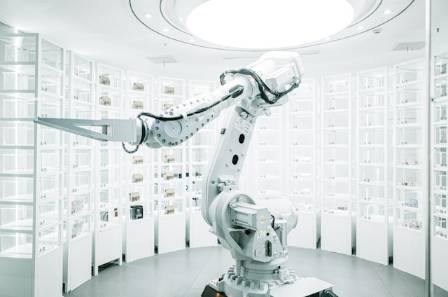
Standard Bots’ RO1 robotic arm is priced at $37,000—roughly half the cost of similar systems from ABB or Universal Robots. Why does this matter? For decades, most small manufacturers have been priced out of automation technologies.
This six-axis collaborative robot (cobot) comes with built-in 3D vision and no-code programming that anyone can operate. Designed and assembled in Glen Cove, New York, the RO1 can lift 18 kilograms with surgical precision, boasting a repeatability of ±0.025 millimeters. The company has secured $63 million in funding to develop AI-driven features that enable robots to learn tasks through human demonstration, a breakthrough that could redefine industrial automation as we know it.
2. The world’s smallest robot is smaller than a grain of salt
The tiniest robot on the planet is so minuscule it could be lost in a sneeze. Developed by engineers at Cornell University, this microscopic machine measures a mere 2–5 microns in width. Cornell previously held the record for the world’s smallest walking robot (40–70 microns), but the new model is far smaller than a grain of salt or even a single human hair.
These salt-sized robots are a game-changer in medical robotics. Equipped with atom-thin platinum hinges on a diffractive panel and controlled magnetically, they can crawl, bend, and squeeze into microscopic spaces.
3. Boston Dynamics robots can do parkour and stick the landing
Boston Dynamics’ humanoid robot, Atlas, is now capable of running, leaping, vaulting, and performing backflips—and yes, it can nail the landing. This isn’t pre-programmed choreography: Atlas scans the terrain, processes the necessary actions, and adjusts in real time on the fly.
Powered by high-performance actuators, advanced vision systems, and dynamic motion planning, this intelligent robot coordinates its limbs with the agility of a gymnast—all with seamless fluidity. You’ll see Atlas execute feats like jumping between platforms, spinning 180° mid-air, and landing in a perfect stance without any human control.
4. AI now lets robots make real-time decisions
One of the most exciting developments in robotics today is that modern robots can make on-the-spot decisions, all thanks to artificial intelligence.
AI-enhanced robots combine sensors, cameras, and machine learning to analyze their surroundings and determine their next steps. For instance, some autonomous warehouse robots can detect obstacles (such as fallen or misplaced boxes), dynamically replan their routes, and—if equipped—report faults or obstacle issues to human supervisors before resuming their tasks.
This capability is what makes today’s robots valuable in unpredictable environments like hospitals, farms, or homes, where conditions are constantly changing. Many robotic vacuums and floor scrubbers use local dirt-density sensors or AI-driven “spot detection” to identify heavily soiled areas, spending extra time cleaning them while moving more quickly over cleaner zones. A farming drone can even identify diseased crops simply by analyzing their color patterns from above.
5. Japan has one of the highest robot-to-worker ratios in the world
No list of interesting robot facts would be complete without mentioning Japan, an undisputed leader in robot adoption. As of 2025, Japan has over 400 industrial robots per 10,000 manufacturing workers—one of the highest density rates globally, second only to South Korea.
In Tokyo, humanoid receptionists greet guests in hotels, robotic servers take orders in cafés, and robots guide passengers in train stations. Meanwhile, Japanese manufacturers rely on precision robotics for automotive and electronics assembly, where even a 0.01-millimeter error can have significant consequences.
Many Japanese robots, such as Pepper or Aibo, are designed for emotional interaction with humans, making them popular in schools, elder care facilities, and therapy settings.
6. Some robots are fixing satellites in outer space
Not all robots reside on Earth. Some operate 22,000 miles above the planet, floating in orbit and quietly extending the lifespan of multimillion-dollar satellites.
In 2025, DARPA’s Robotic Servicing of Geosynchronous Satellites (RSGS) program will use a multi-jointed robotic arm to refuel, repair, or reposition aging satellites that would otherwise become costly space debris.
These autonomous space robots can align themselves with their targets, unlatch protective covers, install or replace hardware, and refuel satellites—all without human intervention.
This is crucial because launching a new satellite costs hundreds of millions of dollars. Repairing an existing one with a robot not only saves money but also helps reduce orbital clutter, a growing threat to future space missions.
7. Robots are now lending a hand in hospitals
Unlike traditional industrial robots, some are built to work safely alongside humans. In hospitals, they now assist with routine tasks such as disinfecting rooms, delivering medication, transporting lab samples, and even performing remote ultrasound examinations.
Many of these robots are voice-activated or equipped with touch sensors, making them easy for non-technical staff to operate.
A fast-growing application is elderly care. Robots like Moxi help nurses with logistical tasks, allowing them to spend more time with patients. Others are being trained to recognize facial expressions, detect falls, and provide companionship to seniors living alone.
Check out our article on working with robots in real-world settings and how cobots are redefining care services.
8. Underwater robots are restoring coral reefs
In Australia and the Caribbean, marine biologists have deployed robots like RangerBot (for navigation only) and LarvalBot. These machines can navigate reef systems and plant baby coral larvae with precision. Swimming independently, they use computer vision to identify areas where coral is missing and carefully deposit coral larvae to regrow damaged sections.
Using robots makes sense because divers have limited underwater endurance, and large reefs span hundreds of kilometers. These semi-autonomous underwater robots can operate for hours, cover more ground, reduce human risk, and support ecosystems critical to ocean life.
9. Some robots can 3D print entire building walls
Take ICON’s Vulcan system, for example. This robotic system lays down layers of concrete to print walls, constructing a home from the ground up in as little as 48 hours of printing time (spread out over several days). No nails, no wood—just a large robotic printer and a detailed CAD file.
These construction robots are being used to address housing shortages in disaster-affected regions and rural areas where labor is scarce. While ICON hasn’t built schools yet, other companies like 14Trees have printed educational buildings in Malawi, proving that this technology is faster than traditional construction methods.
10. Voyager 1 is NASA's longest-operating spacecraft mission
Launched by NASA in 1977, Voyager 1 is still out there, drifting quietly beyond our solar system and sending signals back to Earth from over 15 billion miles away. This makes it both the farthest-traveled robot and NASA’s longest-running spacecraft mission.
Unlike other space robots designed for short-term missions, Voyager 1 has endured for more than 47 years. Powered by radioisotope thermoelectric generators, it carries instruments that continue to transmit data about cosmic rays and magnetic fields in interstellar space—a region no other spacecraft has ever explored.
Compared to today’s robots, it’s quite low-tech: Voyager 1 uses an 8-track digital tape recorder, 16-bit and 18-bit computer systems, and has only about 70 kilobytes of memory—thousands of times less than a modern smartphone. Yet it’s still conducting scientific research.
11. The word “robot” comes from a 100-year-old Czech play
The term “robot” was first used in the 1920s play R.U.R. (Rossum’s Universal Robots) by Czech writer Karel Čapek. Derived from the Slavic word robota, it means “forced labor” or “drudgery.”
In the play, robots are artificial workers created to serve humans—until they eventually revolt.
Interestingly, the “robots” in the play weren’t metal machines; they were more like synthetic biological beings. Nevertheless, the term caught on, and within decades, engineers were using it to describe programmable, task-focused machines.
12. Some robots have synthetic skin and show facial expressions
Machines like Ameca, developed by Engineered Arts, feature lifelike silicone faces and 27 facial motors that allow them to express a surprisingly wide range of emotions.
These robots are programmed to move and interact in a human-like manner. Facial recognition software enables them to read human expressions and respond accordingly, making them ideal for front-desk roles, therapy applications, or social experiments.
13. Robot bees and robot fish are helping scientists study nature
Robot bees are being used in greenhouses to assist with pollination, especially as global bee populations decline. These tiny bots can hover, detect flowers, and even transfer pollen from one plant to another using static electricity.
Meanwhile, robotic fish like SoFi are being deployed in coral reefs and lakes. Swimming like real fish, they monitor underwater conditions and capture close-up videos without disturbing marine life.
Whether pollinating crops or tracking water pollution, these small machines are making a big impact on the planet.
14. Robots can now mimic emotional speech
Thanks to advances in speech synthesis and emotion modeling, some robots can now speak in tones that match human pitch, tone, and mood.
For example, a caregiving robot might soften its voice when interacting with an elderly patient or use a cheerful tone when talking to children.
This is one of the more subtle yet powerful aspects of modern robotics: robots that can mirror emotional tones are more effective in real-world social settings. From classroom tutors to customer support bots, emotional expressiveness enhances trust and understanding.
15. NASA’s Mars rover sings “Happy Birthday” to itself
On the anniversary of its landing, NASA’s Curiosity rover plays “Happy Birthday” to itself on Mars.
Engineers originally programmed the tune using the rover’s Sample Analysis at Mars (SAM) instrument, which can generate vibrations that produce sound. It first performed the song on August 5, 2013, marking the anniversary of its first Earth year on the Red Planet.
Due to energy-saving protocols, the birthday tune isn’t played every year—but that initial moment captured the hearts of people around the world.
This bit of robot trivia reminds us that even the most rugged, science-focused machines can have a poetic, human-like touch.