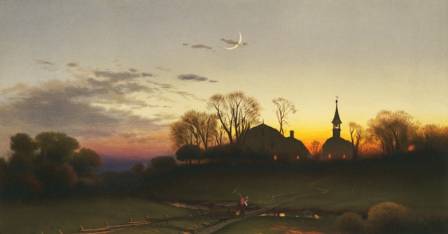
Artists have long been captivated by the natural world, obsessing over its magnificent contours and light for generations. The collection of twilight-themed artworks featured in this discussion illustrates the diverse ways creators interpret the environment. Whether rendered through meticulous sketches, vibrant color play, majestic scenery, or evocative abstraction, these pieces transcend a simple recording of the day's conclusion. The concept of an ending—a subject that deeply intrigues humanity—finds its ultimate visual metaphor in the falling sun. Furthermore, the dramatic shifts in light and the spectacular palettes provided by the atmosphere lead many to believe that the greatest artist of all is the earth itself.
The Evolution of Twilight Imagery in Art
The rise of the Impressionist movement marked a shift where painters prioritized the perception of reality over strict imitation. This transformation provided new avenues for those dedicated to landscape art, particularly those working "en plein air" or outdoors. Through specific color choices, we can discern the atmospheric conditions of the moment, the creator's emotional state, and their overall worldview.
Winslow Homer – Sunset
A primarily self-educated creator, Winslow Homer rose to prominence for his portrayals of American outdoor existence. He began his professional path as a commercial illustrator before finding his voice through oil and watercolor. Driven by a profound respect for the environment, Homer crafted numerous scenes of wildlife, children, and rural life. As his style matured, he became increasingly drawn to the ocean and the persistent tension between humanity and the elements. His piece titled Sunset reflects this deep admiration, evoking a sense of calm as a productive day transitions into a period of rest.
Vincent Van Gogh – Willows at Sunset
Regarded as one of the most passionate figures in modern art history, Vincent van Gogh produced a vast array of landscape paintings created directly in the field. These works serve as both a symbolic mirror of his inner psyche and a reflection of the physical world. Willows at Sunset, thought by scholars to be a preliminary study for a later work, highlights the artist's intense temperament. The energetic brushwork and heavy layers of pigment suggest the piece was executed rapidly, attempting to freeze the movement of the sun, which appears as a dominant, almost sacred icon in the composition.
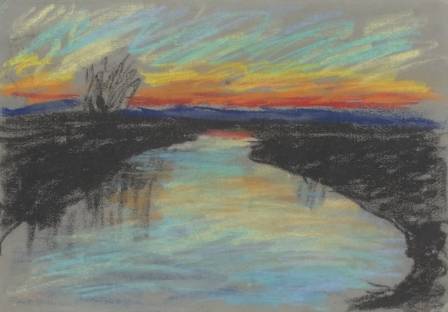
Vincent Van Gogh – Sunset at Montmajour
Van Gogh’s recurring focus on the setting sun is a testament to his search for beauty amidst personal struggle. His inner conflicts were often channeled onto his canvases, resulting in some of the most cherished works in existence. In his oil painting Sunset at Montmajour, he captures a world of vivid extremes. To understand the essence of this work, one can look to the artist's own words in a letter to his brother, Theo. He described a rocky field of twisted oaks with a hillside ruin and distant wheatfields, bathed in golden light that felt like a "shower of gold," turning the fields purple and the horizon blue.
Edvard Munch – The Scream
The world-famous masterpiece The Scream was originally titled The Scream of Nature by its creator, the German Expressionist Edvard Munch. The painting features a distressed figure set against a backdrop of violent oranges and reds, illustrating a profound rift between the individual and their environment. Some historians believe the intense colors of the sky were inspired by Munch's memory of the atmospheric effects following the eruption of Krakatoa. Beyond its fame as a psychological portrait, the work uses the end of the day to symbolize a total disconnection from the self.
Claude Monet – The Houses of Parliament, Sunset
As the foundational figure of Impressionism, Claude Monet championed the "en plein air" method of painting. He was instrumental in shifting art away from realism toward a focus on individual impressions of the world. Monet is often seen as a precursor to abstraction due to his fascination with shifting light and the fleeting nature of time. His depiction of the Houses of Parliament at dusk provides a moody, atmospheric look at the world’s illumination. By painting the same location repeatedly, Monet essentially created a visual chronicle of how light evolves.
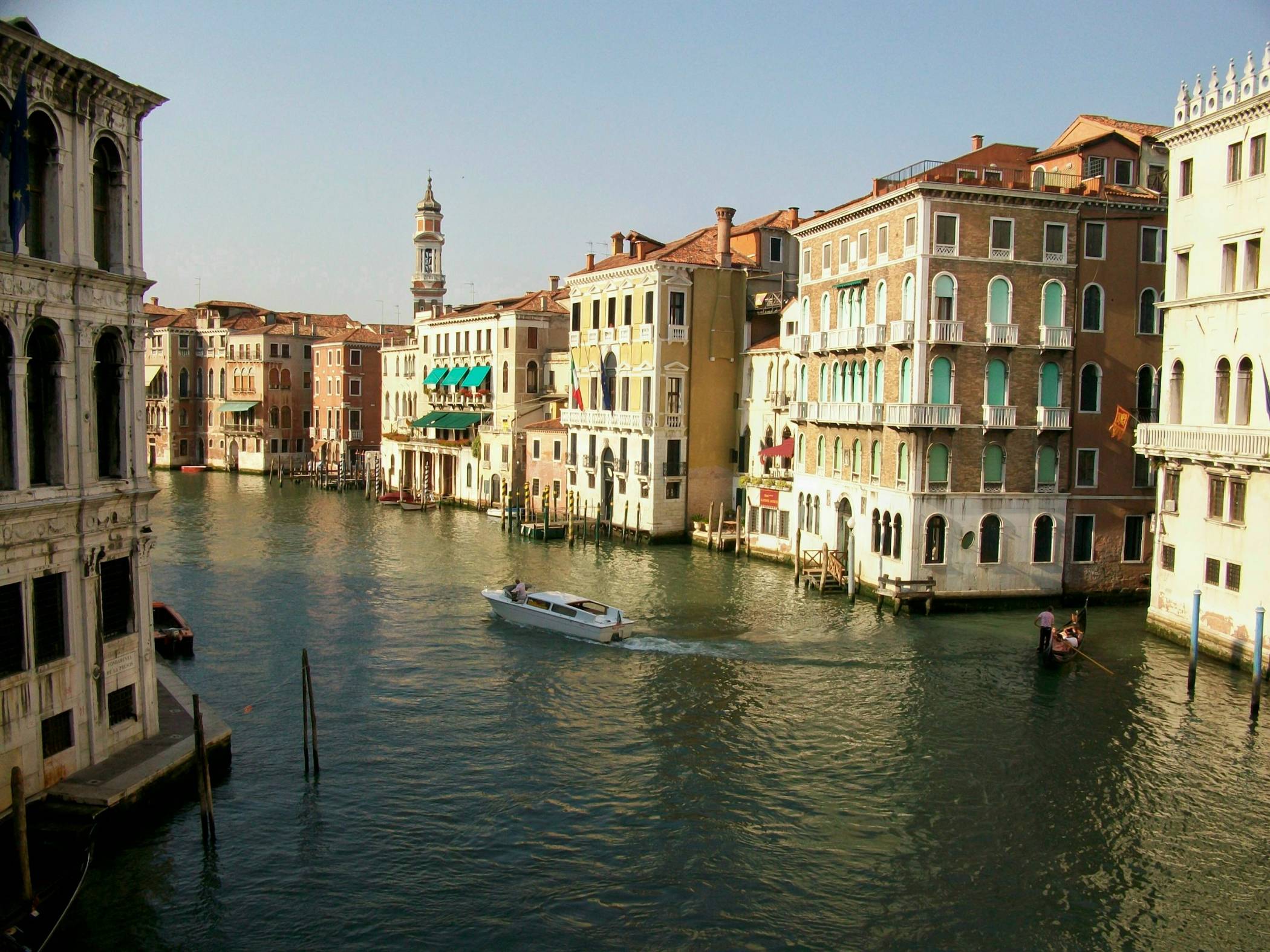
Claude Monet – Sunset in Venice
Later in his career, Monet expressed a desire to paint with the fresh perspective of someone who had just gained sight. He advised fellow artists to focus on the raw essence of color rather than the objects themselves. This philosophy is evident in Sunset in Venice, painted while his own vision was beginning to fail. The work is a triumph of color over form, where the artist prioritized the shapes created by light reflecting across the Venetian lagoon, resulting in a vibrant testament to his artistic principles.
Georgia O’Keeffe – Sunset, Long Island
Often called the pioneer of American Modernism, Georgia O’Keeffe is celebrated for her large-scale floral studies and New Mexico vistas. She sought to distill the natural world into abstract forms to enhance its visual power. Her work Sunset, Long Island is a prime example of this approach. Using smooth, flattened planes of color, she captures the sun as it descends into the Hudson River, creating a bridge between traditional landscape and modern abstraction.
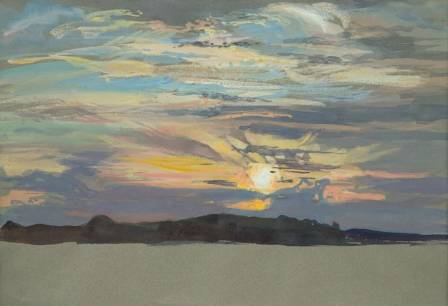
David Hockney – Northern Sunset
David Hockney also explored the abstraction of the environment, notably in Northern Sunset, which offers a rich, stylized view of the midnight sun in Norway. Despite the freezing geographical context, the painting glows with a radiant heat as the sun meets the dark blue of the arctic waters. Hockney, a giant of 20th-century British art, was known for his willingness to abandon established styles in favor of personal expression, a trait clearly visible in his brilliantly colored, grand-scale landscapes.
Shepard Fairey – Evolve Devolve
A central figure in modern American art, Shepard Fairey is famous for works that blend graphic design with social commentary. His contribution to this theme is a lithographic print titled Evolve Devolve, which incorporates collage techniques. Unlike the traditional oil paintings on this list, Fairey’s sunset was created for Earth Day to highlight the global ecological crisis. It uses the beauty of a sunset to provoke thought about the environmental challenges threatening the planet's future.
Koen van den Broek – Sunset
The acclaimed Belgian artist Koen van den Broek draws inspiration from cinematic techniques to create his unique visual language. His paintings often possess the dramatic weight of a film still, suggesting a deep narrative. In his piece Sunset, the story remains intentionally ambiguous. The viewer is left to wonder if the silhouette gazing at the distant town is welcoming the arrival of a new dawn or bidding a final, somber farewell to the day.