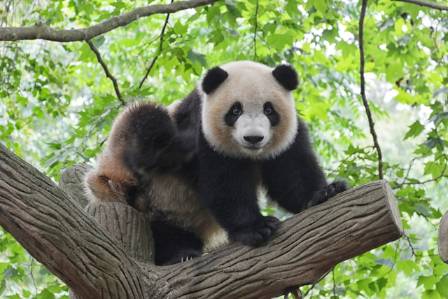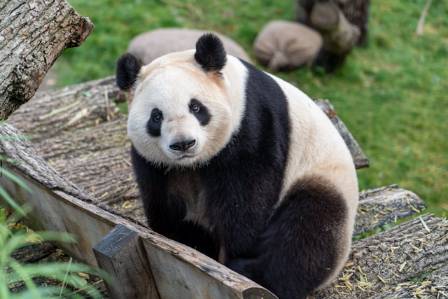
Lately, I’ve been reflecting a lot on these remarkable animals, especially after re-watching one of my favorite films, Kung Fu Panda. Curious, I did some digging and discovered that pandas are not only fascinating and endangered, but they also hold deep symbolic meaning in Chinese philosophy and spirituality.
Here are some fascinating insights about them:
1.Although pandas are technically classified as carnivores, their diet is almost entirely bamboo, which provides only 20-30% of the nutrients they need. As a result, they spend up to 16 hours a day eating.
2.In Chinese, the panda is called dàxióngmāo, which translates to “large bear-cat.” This name comes from the fact that, unlike other bears, their pupils are vertical slits rather than round. Pandas are also incredibly skilled at climbing.
3.Female pandas have a very limited reproductive window, being fertile only once a year for 2 to 3 days.
4.Today, there are roughly 1,600 pandas left in the wild, and the species has been classified as endangered since 1990.
5.In Chinese spiritual tradition, pandas symbolize Yin and Yang. Their black-and-white fur, along with their calm temperament, represents balance, peace, and harmony.
Some ecologists and evolutionary scientists argue that, on a broader ecological scale, pandas are not critical to ecosystem function. Indeed, with no natural predators and a highly specialized diet, their presence has little direct impact on their environment—almost as if they barely exist. In this way, pandas can be seen as natural Taoists, quietly following their path.
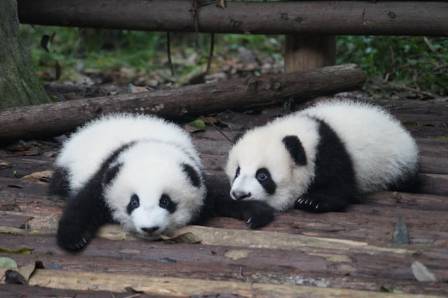
Yet, we must consider the metaphysical implications of allowing these creatures to vanish. Pandas face severe threats from poaching and the rapid destruction of their natural habitats. What does it say about humanity if we permit their extinction? This isn’t about sentimentalism or emotional melodrama—negative actions and cruelty are often rooted in unconsciousness. The panda teaches lessons about awareness and mindfulness that are easily overlooked.
I’ve written extensively about the importance of being present, so I won’t lecture further here. Still, it’s worth noting: while the panda may not be essential for human survival or even the health of the planet, its presence reminds us that some of the most valuable things in life are not practical or necessary. Like education, love, or money, the panda shows us that the simplest and seemingly “unnecessary” experiences can carry profound beauty and meaning.