The River Thames is the principal waterway of southern England. It begins its course in the Cotswold Hills, with a drainage basin spanning about 5,500 square miles (14,250 square kilometers). Its conventional starting point at Thames Head, often without water for large parts of the year, is marked by a stone slab set in a field 356 feet (108.5 meters) above sea level, situated 3 miles (5 km) southwest of Cirencester. However, some argue that the River Churn, a tributary originating near Seven Springs village at 700 feet (213 meters) above sea level, just south of Cheltenham, holds a stronger claim as the true source.
Physical Characteristics
Stretching approximately 205 miles (330 km), the Thames flows about 140 miles (226 km) from its source to the start of tidal influence—Thames Head to Teddington Lock—and continues another 65 miles (104 km) as a tidal estuary from there to The Nore sandbank, where it meets the open sea. Its catchment area, which experiences an average yearly rainfall of 27 inches (688 mm), has a varied geology. In its upper reaches, the river drains a wide triangular zone bordered by the chalk ridges of the Chiltern Hills and the Berkshire Downs to the east and south, the Cotswolds to the west, and the Northamptonshire highlands to the north. It breaches the chalk escarpment at Goring Gap and then collects water from north of the North Downs. The final major tributary, the River Medway, draws from the low-lying Weald region of Kent and Sussex south of London.
The Thames flows calmly across placid, undulating lowland terrain, characterized by a gentle, pastoral quality. Its gradient from Lechlade to London averages under 20 inches per mile (32 cm per km). Tides and oceanic surges significantly influence water levels in the lower sections. This tidal effect starts to be noticeable intermittently—for about three hours at high tide—as far upstream as Teddington in London's western outskirts. The shift from freshwater river to tidal estuary becomes more definite around Battersea in central London. At London Bridge, in the city's core, the water level increases by up to 22 feet (7 meters) during spring tides and 18 feet (5.5 meters) at neap tides.
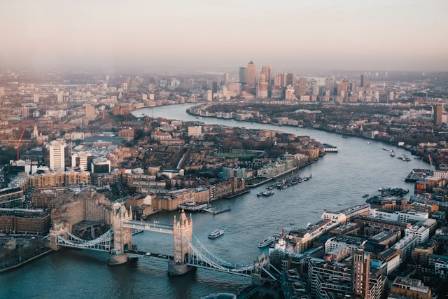
The mean discharge at Teddington, the upper boundary of the tidal section, is 1,856 cubic feet (53 cubic meters) per second, which can increase to 4,640 cubic feet (130 cubic meters) per second following winter precipitation. During severe flooding, such as in March 1947, the flow over Teddington Weir may reach 20,900 cubic feet (590 cubic meters) per second. Reports suggest that after intense storms in 1894, an average of 31,310 cubic feet (887 cubic meters) per once passed over the weir. In high flow conditions, the river can overwhelm incoming tides, causing a continuous downstream current for several days below Teddington. Conversely, powerful spring tides may surpass the weir and affect the river’s flow up to 2 miles (3.2 km) above Teddington. The serious flood risk that tidal surges pose to London’s subterranean networks, structures, and residents led to the building of the Thames Barrier at Silvertown (finished in 1982) and the installation of extensive flood defenses along the whole tidal section.
Exploring the Thames
Small boats can navigate the Thames as far upstream as Cricklade's town bridge, near the source, though larger motor vessels and barges must turn back at Lechlade, 10 miles (16 km) farther down. Winding softly across flat landscapes for the initial 28 miles (45 km) between Cricklade and Oxford, the river passes Kelmscott Manor—the stone house with gables that was home to William Morris, the 19th-century designer, socialist, and poet, who is buried in the local churchyard. Before arriving at Oxford, the Thames (also known by its literary name, Isis) curves north around the forested hills of Wytham and Cumnor, which look over the city from the west. A branch of the river at Wolvercote leads to a former mill that produced fine paper for the Oxford University Press from the early 1600s until 1943. Around the gravelly areas of this famous university city, the river in summer is busy with slender punts, rowing eights, and small boats. Colorful narrowboats (canal barges) can also be observed traveling to or from the West Midlands and northern England via the Oxford Canal.
At Oxford, the Thames is 150 feet (46 meters) across. Fed by three northern tributaries—the Windrush, Evenlode, and Cherwell—it turns south past the Nuneham woodlands toward the market town of Abingdon. There it meets the River Ock, which flows from the Vale of White Horse. The Thames then turns east and south through the historic settlements of Dorchester (notable for its 14th-century abbey) and Wallingford. It passes between the Chiltern Hills and the Berkshire Downs at Goring Gap, accompanied by the Great Western Railway line in a scenic valley lined with beech woodlands. Emerging from the chalk slopes at Pangbourne, it receives the River Pang. It was here that Kenneth Grahame, a banker and writer, composed the early sections of The Wind in the Willows, celebrating the simple pleasure of “messing about in boats.”
Economic Aspects
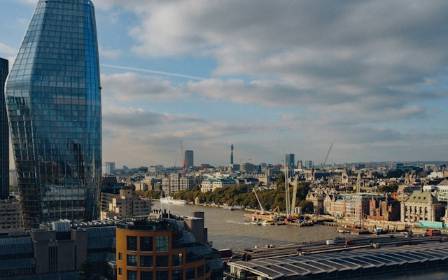
Like other inland waterways in Britain, commercial shipping on the Thames decreased throughout the 20th century, nearly disappearing after World War II. More surprising was the decline of maritime trade in London—especially compared to ports such as Rotterdam in the Netherlands. From the 1970s, the Port of London Authority focused its investment on modern cargo facilities at Tilbury, 20 miles (32 km) downstream from the city. Starting in the 1980s, the once industrial London docks and waterfront underwent rapid renewal, with warehouses and factories making way for residential and commercial developments, walkways, and green spaces. Once considered biologically dead in the 1950s, the river has experienced a remarkable recovery due to shifting land use and stricter environmental regulations, leading to cleaner water and the return of numerous fish species. See also London Docklands.